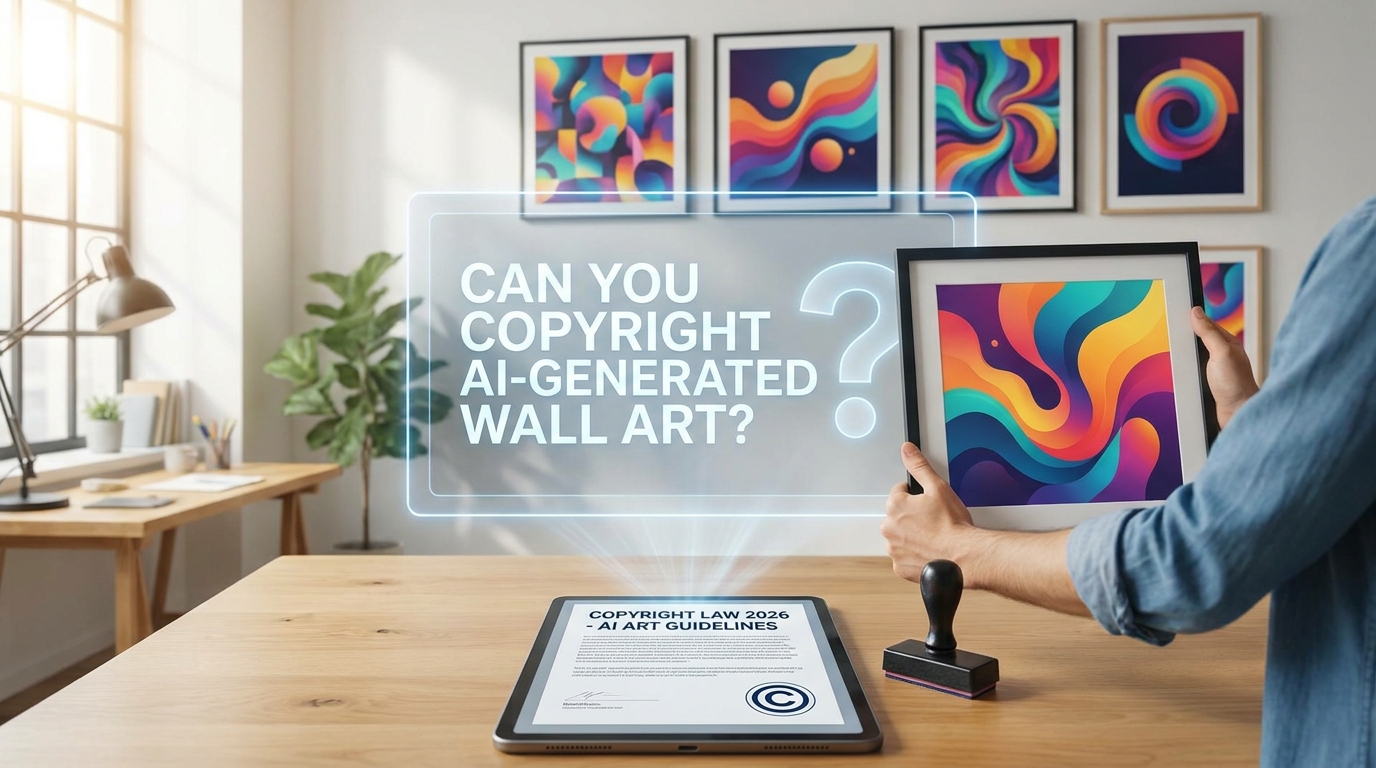
People hear "custom AI wall art" and often assume one payment buys everything: the print, the file, the copyright, and the right to stop anyone else from making anything similar. That is the real problem. Those rights are not the same thing.
Short answer: Can you copyright AI-generated wall art in 2026? Sometimes, but not automatically.
As of April 21, 2026, the clearest public guidance comes from the U.S. Copyright Office and U.S. courts. That is why this article uses U.S. law for the clearest examples.
But if you are in Europe, the broad direction is similar. The EU still centers originality and human creativity, even though it does not yet have one simple all-EU rule for AI-generated works. So the practical takeaway in both places is close: human creative input matters.
This is a practical overview, not legal advice. Copyright rules vary by country, and if you are selling work or facing a dispute, speak to a qualified lawyer.
What You Buy vs What You Own
Quick takeaway: owning a print, owning a file, and owning copyright are three different things.
- Owning a print means you own the physical object.
- Owning a file usually means you have access under a license or terms of use.
- Owning copyright means you control reproduction, derivatives, licensing, and certain enforcement rights.
That distinction matters because buyers and sellers constantly blur it.
If a framed piece arrives at your home, you own that physical copy in the normal everyday sense. You can hang it, gift it, or resell that copy.
If you receive a digital file, you usually get it subject to terms. Those terms may let you print it again, post it online, or use it commercially. They may also limit those rights.
Copyright is the separate legal layer. You do not get copyright automatically just because you bought a print or received a file.
Example: you order a framed wall piece for your dining room. You almost certainly own that framed copy. That does not automatically mean you can turn the image into posters, sell the file on Etsy, or stop someone else from getting a similar-looking result from the same creation tool.
That is why vague lines like "you bought it, so you own it" are not helpful. The real question is: which rights, exactly?
Can AI Art Be Copyrighted?
Quick takeaway: yes, sometimes. But "AI-generated" and "copyrightable" are not the same thing.
In the U.S., current guidance still asks whether a human author determined enough of the expressive result.
The U.S. Copyright Office said in guidance published on March 16, 2023, and in its AI copyrightability report published on January 29, 2025, that prompts by themselves are often not enough. The D.C. Circuit reinforced the human-authorship baseline on March 18, 2025 in Thaler v. Perlmutter.
In the EU, the law is less neatly packaged into one rule for AI outputs. But the core idea still points toward human creativity and the author's own intellectual creation. So the practical answer is still close: more human creative contribution usually means a stronger copyright position.
Prompts alone are not a reliable shortcut to copyright. A prompt like "moody abstract seascape in blue and gold" may produce something beautiful. Beauty is not the legal test. Human authorship is.
Buyer warning: if a seller promises "full copyright on every AI image," treat that as a red flag, not a premium feature.
Where Human Authorship Changes Things
Quick takeaway: the more the human shapes the expressive result, the stronger the argument.
Lower-control case: someone enters a short prompt, gets one raw output, makes little or no meaningful edit, and sells it as-is. That work may still be usable under platform terms, but the copyright claim is much less certain.
Stronger-authorship case: someone sketches, chooses reference directions, adjusts composition, iterates repeatedly, masks, retouches, collages elements, paints over details, adds typography, or meaningfully selects and arranges the final expression.
That is the practical dividing line. Human authorship can come from:
- meaningful creative control
- visible human-created elements
- substantial human editing or arrangement
The tool can assist. The human still needs to shape the result in a meaningful way.
A simple way to think about it: if the interesting part of the image mostly comes from your own composition, editing, and judgment, your position is stronger. If the interesting part mostly comes from the model surprising you, your position is weaker.
If exclusivity matters to you as a buyer, ask how the piece was actually made. Was it mostly a raw output, or was there substantial human art direction and finishing?
Originality, Similarity, and Style References
Quick takeaway: originality is not a magic shield, and style references can still create practical risk.
Originality does not mean nobody has ever made anything remotely similar. It usually means the work was independently created and contains enough creative expression.
But that does not protect you if the result lands too close to a specific existing work.
Similarity concerns are very real if an image ends up looking too much like a known poster, illustration, photograph, game asset, or branded visual.
That risk gets even sharper when famous characters, logos, branded products, or recognizable franchise elements show up.
Style references are where people get sloppy. Style itself is not the same as copying a specific protected image. But in practice, marketing something as "in the style of [living artist]" is still risky.
Why? Because it invites obvious lookalikes, customer confusion, and messy expectations.
Safer prompt direction: "dreamy floral still life with loose brushwork, muted peach and sage palette."
Riskier prompt direction: "make me a Matisse-style flower piece."
Sellers should also avoid implying that every machine-assisted output is automatically legally clean. That is not how this works. Similar images can happen. Unexpected overlaps can happen. Review still matters.
What Customers Should Realistically Expect
Quick takeaway: you may get broad usage rights without exclusive copyright.
- Similar images can happen.
- Terms matter more than vibes.
- If exclusivity matters, ask direct questions before you buy.
A seller may give you permission to print, display, and use the file commercially while still not promising that you hold exclusive copyright in the image.
If the seller's terms say similar or even identical results may occur, believe that sentence. It matters more than the marketing page.
If the checkout page says "you own your art" but the legal terms only grant a license, the terms are doing the real work.
If exclusivity really matters, ask:
- Is this licensed or assigned?
- Is exclusivity promised in writing?
- Was substantial human editing part of the process?
- What happens if similar outputs appear later?
At Primpter, the current terms say generated images are licensed for personal and commercial use, and that similar or identical images may be generated for other users using similar prompts. That is a more honest expectation than pretending every wall piece comes with automatic exclusive copyright.
Buyer example: if you order a large framed print for your office lobby, you can reasonably expect to display that print and use the file according to the license you were given. You should not automatically expect the right to resell the file, claim exclusive ownership of the expression, or block every similar image made later.
What Sellers Should Never Overpromise
Quick takeaway: accurate marketing beats confident nonsense.
Do not claim:
- "You automatically own full copyright."
- "Every AI image is legally original."
- "Style prompts are always safe."
- "No one else can ever get anything similar."
Better language is more specific and more defensible.
Safe language:
- "You own this print."
- "You can use this file under the license in our terms."
- "We do not promise exclusivity unless stated in writing."
Misleading language:
- "Full copyright guaranteed on every AI image."
- "100% legally unique."
- "In the style of [living artist], no risk."
Seller example: if you run a wall art store and advertise "exclusive copyright included" on raw AI outputs with minimal edits, you are not being bold. You are setting yourself up for unhappy customers and possibly worse.
FAQ
Do I own the print if I buy it?
Generally, yes. You own that physical copy. That does not automatically give you copyright in the image itself.
Do I own the file if it is emailed to me?
Usually you receive the file under a license or terms of use. Check what those terms actually allow.
Can I register copyright in AI-assisted wall art?
In the U.S., sometimes, but it depends on the level of human authorship in the final work. In the EU, the practical direction is also human-centered, but the legal picture is less neatly unified across member states.
Are prompts enough to make me the author?
Not reliably. As of April 21, 2026, prompts alone are generally a weak basis for a confident copyright claim in the U.S., and they are not a strong shortcut in the EU either.
Is "in the style of" illegal?
Not automatically, but it is risky and often a bad business habit. Style references can drift into obvious imitation or misleading marketing very fast.
If I want exclusivity, what should I ask for?
Ask for written terms covering exclusivity, assignment or license scope, process details, and what happens if similar outputs are created later.
Conclusion
The useful answer is less dramatic and more honest: buying AI-generated wall art does not mean you automatically own everything connected to it.
You may own a print. You may receive a file. You may get a broad license. In some cases, there may also be a real copyright claim tied to meaningful human authorship.
But those are separate questions.
If you're buying, read the terms and ask direct questions. If you're selling, say exactly what rights the customer gets and stop pretending certainty exists where it does not.
That may sound less exciting than "full ownership guaranteed," but it is much closer to the truth.